

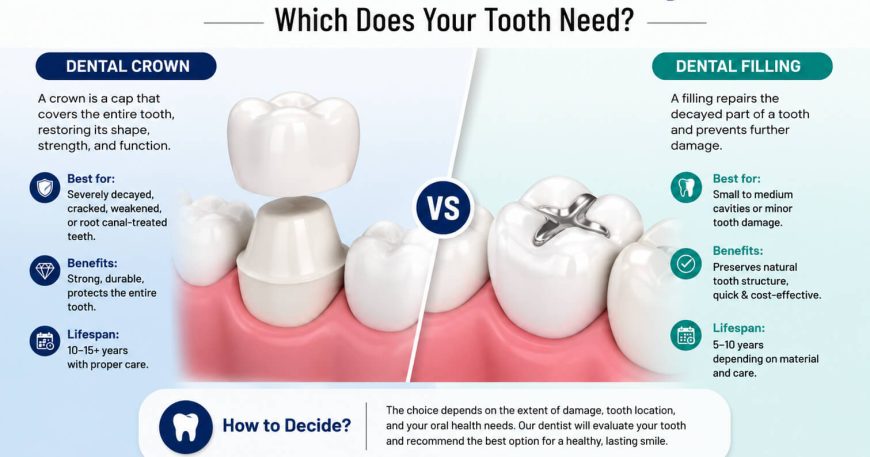
Whenever there is a tooth damage caused by decay, breakage, and erosion, the most common question that comes up is this: Should I go for dental crowns or fillings?
Dental crowns and fillings are similar procedures because they both involve fixing damaged teeth to prevent pain and improve the overall state of your dental health. However, these treatments differ in terms of how much damage there is and what needs to be done.
Knowing when you need either of the two can help you decide what is best for your dental health and prevent future damage.
In this blog post, we will discuss the dental crown vs filling battle to give you some information to ponder on.
What Is Dental Filling?
Dental fillings are a method of restoration that can be performed to restore small to moderately decayed or damaged teeth.
The filling involves the removal of the decay from the tooth and replacement of that area with a strong substance like a composite resin or a ceramic compound. The tooth is thus made sound again.
Fillings are recommended in cases where there is no extensive tooth loss and the tooth does not require reinforcement.
Common Reasons You May Need a Filling
- Small to moderate cavities
- Minor tooth cracks
- Early tooth decay
- Worn-down teeth
- Small spots of damaged enamel
Fillings usually save time because when done early enough, it is possible to fix the tooth problem without future complications.
What Is a Dental Crown?
The dental crown, alternatively known as the “tooth cap,” is a customised restoration that fully encases the part of a compromised tooth that is visible.
In contrast to the dental fillings, the dental crowns encapsulate the whole tooth because fillings treat only particular areas.
Crowns can be made up of different materials such as porcelain, zirconia, ceramic, metal, or a combination of two or more of these materials.
Common Reasons You May Need a Crown
- Large cavities that affect the strength of the tooth
- Fractured teeth
- Root canal treated teeth
- Excessively worn out teeth
- Failed fillings, leaving little of the natural tooth material
- Aesthetics—restoring damaged teeth for improved look
Crowns can be used for improving appearance and functionality at the same time as they cover the natural tooth.
Dental Crown vs Filling: Understanding the Difference
Though both treatments serve to repair decayed teeth, there is significant difference in their extent of coverage.
Dental Fillings
In dental filling, the affected area of the tooth is restored. Filling is viewed as a more conservative treatment since there is removal of less amount of natural tooth.Some advantages of filling are:
- It involves a shorter procedure
- It is cheaper than dental crowns
- It preserves natural tooth structure
- It repairs small areas of cavities
- Can be completed within one visit
Dental Crowns
In the dental crown, the entire tooth is covered, thus offering total protection.
Advantages of crowns are:
- It offers greater strength
- It prevents fractures in the future
- It treats heavily damaged teeth
- Improves chewing ability
- Aesthetically pleasing for visible teeth
It all boils down to the health status of the tooth when deciding between a crown and a filling.
When Do You Need a Crown Instead of a Filling?
There have been many occasions on which the patient wants to know if a crown is needed in place of a filling.
There is a possibility that the patient might need to get a crown if he/she loses a great deal of tooth structure such that it is unable to support any more fillings.
Some of the reasons that require a crown include:
- Damage of over half of the tooth
- The existence of a large filling that is worn out
- Fracture of the tooth
- Root canal treatment
- Teeth subjected to a great deal of biting forces
- Risk of fracture
When Is Filling the Better Option?
A dental filling is typically preferred in cases where the damage is limited and the tooth itself retains its structural integrity.
If the following conditions exist, your dentist may opt for a filling:
- There is an early diagnosis of decay
- The cavity is small or medium in size
- There are no visible cracks in the tooth
- The tooth structure is in good condition
- The tooth can endure typical chewing pressures
Tooth Filling vs Cap: Which Lasts Longer?
Durability plays an important role when comparing tooth fillings and caps.
Crowns usually have a longer life span compared to fillings as crowns protect teeth completely.
The life span of both restorations will depend on a variety of factors including the patient’s oral hygiene, their diet, bruxism, and dental visits.
Typically:
- Fillings can last several years.
- Crowns may offer longer-lasting protection.
However, regardless of the restoration chosen, good oral hygiene will be crucial for increasing its longevity.
What Happens If You Choose the Wrong Treatment?
Making a choice between a filling material for a heavily compromised tooth may cause:
- Increased cracking
- Decay recurrence
- Filling complications
- Tooth cracks
- Increased future costs
In the same vein, the placement of a crown when a filling will be sufficient is another case of over-treatment.
For this reason, a proper dental exam is highly recommended prior to making the best choice.
How Dentists Decide Between a Crown and Filling
The factors that determine the type of restoration to use are:
- Size of the cavity
- Extent of existing healthy tooth structure
- Any presence of cracks or fractures
- Location of the tooth
- Masticatory forces involved
- History of past dental treatments
- General oral health
Modern technology in dental imaging and clinical evaluation allows the dentist to ascertain which is the optimal treatment modality.
How to Prevent the Need for Crowns and Fillings
Though restorative therapies are highly effective, prevention is the most effective approach.
The following ways help prevent dental decay and damage:
- Brushing two times per day using a fluoride toothpaste
- Flossing on a daily basis
- Avoiding foods rich in sugar content
- Wearing a mouth guard for grinding teeth
- Regular dental checkups
- Quick treatment of dental caries to avoid complications
It becomes easier to treat the issues when identified at an early stage.
Need Expert Advice About a Damaged Tooth?
The decision about whether to use a dental crown or a dental filling will depend on the level of damage to the tooth, the condition of the remaining tooth tissue, and your oral health objectives.
Whereas a dental filling is perfect for restoring small parts of damaged tooth tissue, a dental crown will be the more appropriate treatment for severely worn-down teeth. The knowledge regarding the crown vs. filling issue should enable you to make the best decisions for your dental health.
Here at Wisdom Bites Dental Clinic, our dedicated dental specialists will carry out an assessment on your tooth to determine which treatment is right for you—a dental filling or a dental crown.
Frequently Asked Questions
1. Crown versus Filling: Which One Is Better?
Ans. There is no definite answer. Everything depends on the condition of your teeth—whether you have more tooth damage or not.
2. Can a tooth with filling get a crown?
Ans. Yes. Sometimes, teeth become weaker or sustain other damage, and it might be necessary to replace the filling with a crown.
3. Does crown procedure hurt more than filling?
Ans. No. Both operations involve the use of local anesthesia to ensure that you experience no pain at all.
4. Is a crown procedure safer than a filling one?
Ans. Yes. A crown will give your tooth more protection than any other material.
5. Can I have my large cavities filled?
Ans. Not always. In case of excessive tooth loss, the best solution is a crown.
6. How will I find out which one I need?
Ans. Your dentist will take an x-ray to evaluate the situation and choose a proper treatment method.
